Read jGirls+ editor Ella Schreiber’s interview with Alessandra on this project and her participation in the Kol Koleinu Teen Feminist Fellowship!
Sexism and antisemitism are often discussed separately, each having its own history and set of challenges. However, for Jewish women, the intersection creates a unique experience. From stereotypes to dismissal of one concern in favor of the other, the intersectionality manifests in ways that can affect everyday life. Through a survey of Jewish women across different age groups and backgrounds, I sought to explore these experiences, uncovering how sexism and antisemitism intertwine and what steps can be taken to address them.
To understand this intersectionality better, it’s important to define a couple terms.
Sexism: Prejudice or discrimination based on sex. Specifically, discrimination against women.
Antisemitism: At its most basic level, the hatred or prejudice against Jewish individuals or Jewish society as a whole.
My survey gathered 21 responses. I first collected demographic information, then asked about experiences and opinions related to sexism and antisemitism.
Most responses came from respondents ages 25-33, although I also had three respondents under the age of 18 years old, and eight between the ages of 34 and 55. Participants were asked to self-describe their race/ethnicity. The majority (17) of respondents described themselves as Caucasian, white, or white Jewish. I also had three respondents who self-described as Hispanic, Latina, or white Hispanic (from Spain). One respondent simply wrote “Jewish.” 12 identified as residing in an urban location, and 9 from suburban locations. While this is a small sample size for a qualitative study, I arrived at some insights by reading people’s individual comments.
One notable finding was that younger respondents tended to see these forms of discrimination as more distinct, while older individuals saw them as intertwined.
How connected do you see antisemitism and sexism in society?
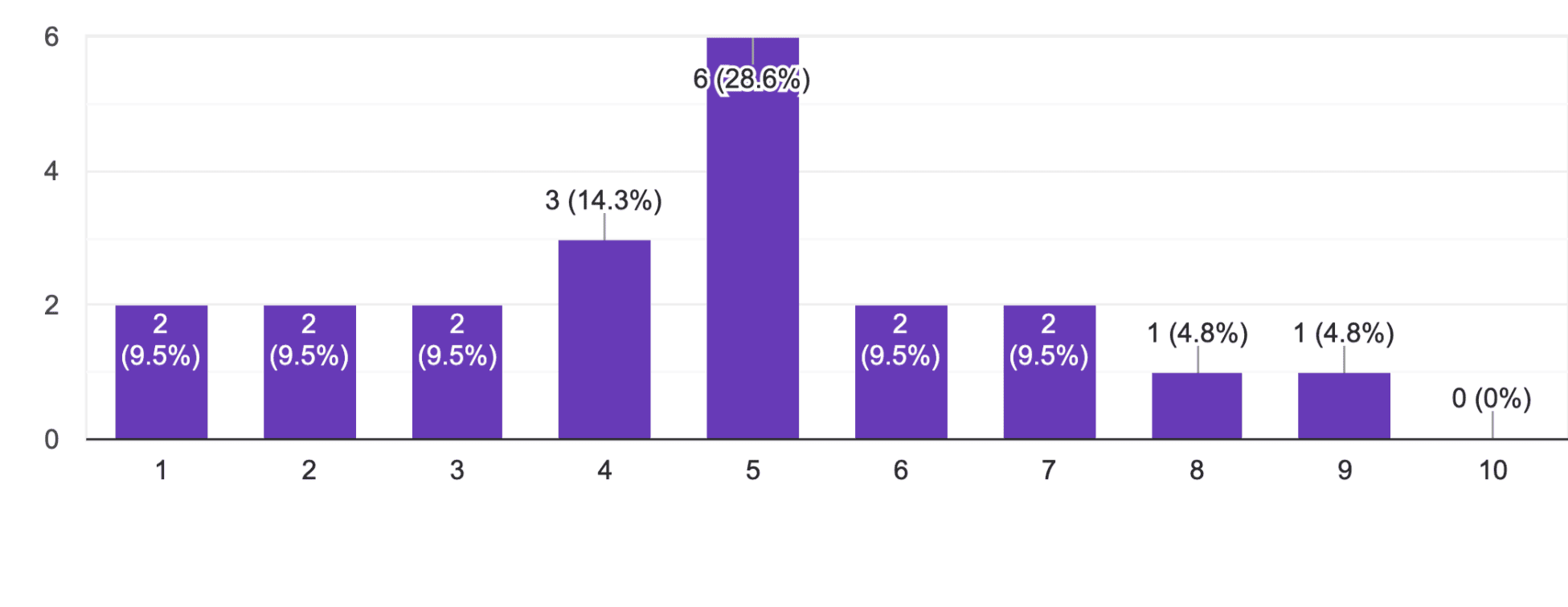
This bell curve suggests that most people see the two as at least a little, if not very connected, as 1 corresponds to “not at all” and 10 corresponds to “extremely.”
Almost every single respondent had personally experienced sexism and antisemitism.
Sexist microaggressions (everyday behaviors or comments, intentional or unintentional, that communicate derogatory or negative messages) included many sly comments and unfunny “jokes.” Respondents said:
- “I was called a ‘know-it-all’ for asking a question. My male counterpart was called ‘responsible’”
- “Always being told to be quieter by family vs saying an opinion.”
- “Questions about why I don’t want to marry or have kids.”
- “I am a 36 yr old woman who drinks whiskey and beer. Frequently I’ve had male bartenders question my order and say things like ‘You know that’s a hoppy beer, right? Are you sure you don’t want a nice glass of wine?’ It’s frustrating.”
Multiple women noted pay differences between them and male counterparts, and many expressed being the target of unwanted attention.
Examples of antisemitism overall seem more overt. Respondents heard comments such as “I didn’t know Jews could run” or noticed swastikas carved into a desk at school. One respondent stated, “I am very gentile-passing, so I mostly overhear antisemitic comments that aren’t intended directly for Jewish ears (like ‘jokes’ about Jews being money-grubbing, complaints about Orthodox Jews entering local politics, or swastikas drawn where people don’t think any Jews are working). I have experienced them much more when living in rural/suburban locations than in cities.” Another respondent stated, “My husband used to wear a kippa in public and I experienced antisemitic harassment on the subways and streets when with him, including someone following us yelling. He no longer wears it. The other thing that comes to mind is that one time during Covid my shul was praying outside in a park. A young man came up and started screaming ‘Fuck the Jews.’ Our security guard tackled him and walked him away from the scene.”
These also included examples of antisemitism on social media:
- “A kid on snap sent a pic with a filter that made his nose look big and said ‘look i’m jewish’. I gave him a little speech about antisemitism and he blocked me.”
- “Recently, a lot more overt antisemitism on social media? And in the past I’ve noticed ignoring or invalidation from non-Jewish friends.”
One survey question that elicited strong reactions was about the term “JAP” (Jewish American Princess), an insult used to refer to a Jewish girl who is spoiled, rich and entitled. Nearly everyone expressed anger or annoyance toward this stereotype and the associated derogatory term, and about half expressed personal experience with it, highlighting the harm caused by such microaggressions that target both Jewish and female identities simultaneously. One respondent wrote, “I have had my female Jewish identity (Jewess) associated with my socioeconomic status (upper middle class) which was then paired inaccurately with personality characteristics (uncaring, oblivious, selfish, etc).”
One respondent, a married Orthodox Jewish woman, spoke directly on the intersection of sexism and antisemitism, sharing an interesting perspective. “As an orthodox jew I actually have different feelings about sexism. A lot of people view orthodoxy as sexist. And while I agree some elements of it can be, there are other parts that I do not find sexist and rather find empowering—elements that others would maybe find sexist. And to me what is actually more offensive is the assumption that I should find certain things oppressive and sexist as a woman, and that I shouldn’t have the room to feel empowered if that’s how I feel.” This perspective is unique in that the feeling of oppression actually comes from the expectation that an Orthodox Jewish woman should feel more oppressed by her identity, and this speaks further to the assumptions placed on people who fit both of these categories.
Another question I asked was, “Do you feel pressured to prioritize one over the other when advocating for social justice?” (This referred to aspects of the respondents’ identities.) Around half of respondents said no, along with comments such as “I approach them separately” and “Not pressured but more comfortable and safe as a woman than as a Jew.” The other half seemed split, with multiple mentioning feeling more drawn to advocate on Jewish issues, as that is the minority group. However, others “feel more called to [their] female identity than [their] Jewish one.” One person said, “Sexism over antisemitism because sexism feels more pervasive and impacts more realms of life than antisemitism. It also maps on to more legislation whereas [advocating against] antisemitism is more about changing attitudes and combating hatred.” This lack of alignment is understandable as these issues can manifest in different ways depending on factors such as age and geographic location.
The final question I asked on the survey was, “Is there anything you wish institutions did differently to handle these issues?” The majority of responses indicated a desire for institutions to speak up. There seems to be a large desire for dialogue and direct denouncements of antisemitism. One respondent stated, “I wish [leaders] would be trained/taught not to gaslight. If we go to an institution with a discrimination complaint, it’s often met with a ‘I’m sure it wasn’t meant in that way’ response. If every institution spent five minutes making a call and checking on complaints, it would be a wake up call for many. Some people don’t realize they’re saying/doing things viewed as discrimination. A simple ‘did you realize your words were viewed as sexist?’ would go a lot further than gaslighting.”
To address these issues effectively, I believe both individuals and institutions must take proactive steps. I especially think education is important, as microaggressions can be unintentional and rooted in misinformation or lack of information. This would manifest in teaching people to be mindful of language and avoid using derogatory terms or stereotypes, and making sure to challenge and correct instances of microaggressions when they occur. By fostering awareness around microaggressions and challenging harmful stereotypes, we can work to create a more inclusive and equitable society. Education and open dialogue are essential in challenging assumptions and making sure that Jewish women are neither silenced nor forced to choose which part of our identity to defend. Progress lies in recognizing that these forms of discrimination are not always separate battles but interconnected forces that demand action. I encourage discussion more than anything: with friends, family, administration; make yourself heard.
Reference List:
https://www.adl.org/spelling-antisemitism-vs-anti-semitism
https://forward.com/fast-forward/537962/dictionary-com-adopts-antisemitic-as-spelling
https://thebrownandwhite.com/2015/02/12/womens-center-discusses-etymology-implications-jap/
Join the conversation!